Thermal Sensitivity in Artificial Insemination: How Small Temperature Variations Affect the Fertility of Porcine Semen Doses
Author: Maiko G. Philippe (Veterinarian and Specialist in Animal Reproduction)
Introduction
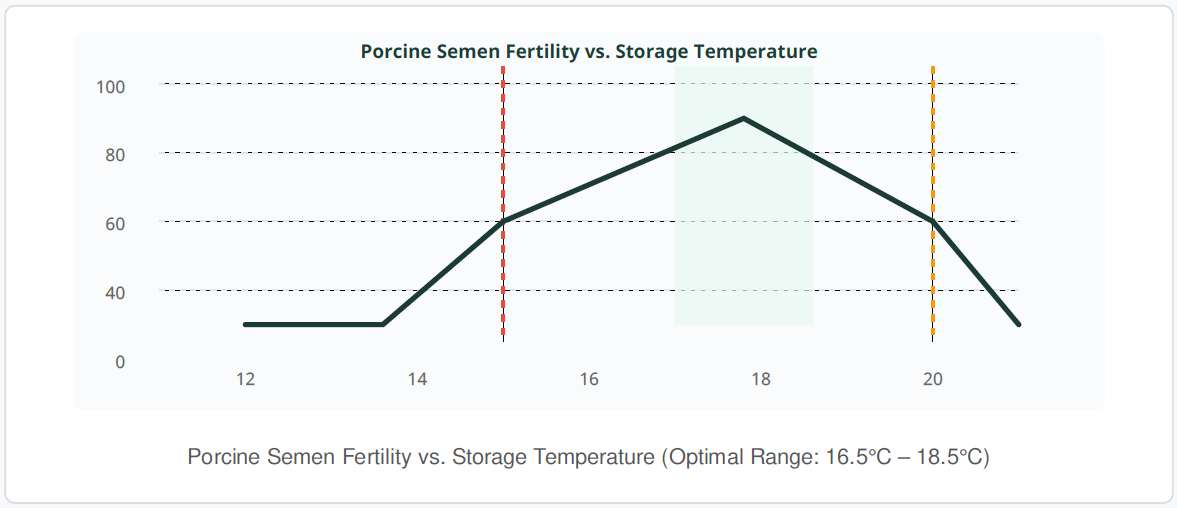
In modern swine production, genetic progress and reproductive efficiency heavily depend on the precision of artificial insemination (AI) protocols. Because porcine spermatozoa do not tolerate the cryopreservation process well without significant losses in viability and fertility, liquid storage between 15°C and 18°C remains the global gold standard for commercial swine production. However, maintaining this narrow temperature range represents a massive engineering and biological challenge. Unlike mammalian body tissues, which rely on complex homeostatic regulation mechanisms, porcine spermatozoa diluted in extender media remain highly vulnerable to environmental temperature fluctuations. Seemingly irrelevant thermal deviations — such as a 2°C or 3°C oscillation during transport or on-farm storage — can trigger irreversible metabolic dysfunction, structural damage to the plasma membrane, and a drastic drop in litter size and farrowing rates.
Why This Topic Matters
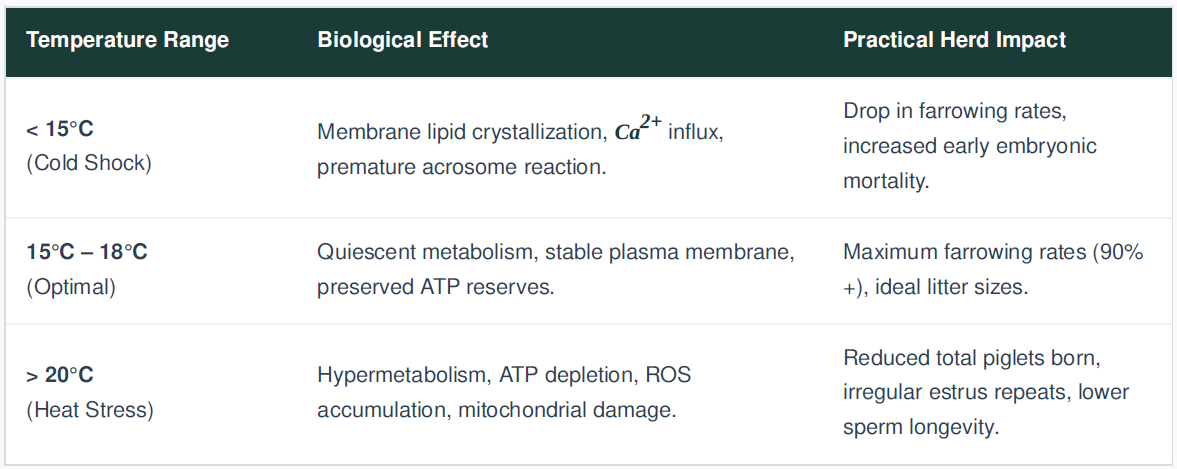
Reproductive performance directly dictates the economic viability of a swine farm. The farrowing rate and total number of piglets born per litter are the primary drivers of weaned piglets per sow per year (PSY). When semen doses experience inadequate thermal exposure prior to insemination, the consequences do not manifest as an immediate total failure, but rather as insidious subfertility: lower conception rates, increased returns to estrus, and irregular litter sizes. Farm managers frequently misdiagnose these symptoms, attributing them to boar fatigue, estrus detection failures, or sanitary issues, completely ignoring the semen storage unit or transport box. From a biological standpoint, porcine spermatozoa possess a high proportion of polyunsaturated fatty acids (PUFAs) in their plasma membrane, making them exceptionally fluid yet remarkably sensitive to thermal stress. When the storage temperature drops below 15°C, lipid phase transitions occur, destroying membrane integrity and causing thermal shock. Conversely, when temperatures rise above 20°C, sperm metabolism accelerates exponentially, resulting in rapid depletion of energy reserves (ATP exhaustion), accumulation of toxic metabolic byproducts (lactic acid), and premature cell death. Understanding and controlling these microvariations therefore constitutes a fundamental pillar of quality control in high-health and high-productivity production systems.
Main Technical Content
To understand how minor thermal deviations impact fertility, one must examine the physiological state of spermatozoa stored in liquid extenders. Diluted semen is maintained in a state of metabolic quiescence — a suspended animation designed to preserve cellular energy reserves until fertilization occurs within the female reproductive tract.
The Cold Stress Axis (< 15°C)
When a semen dose is exposed to temperatures below 15°C — a frequent situation when doses are positioned too close to the cooling element of transport boxes or refrigerators — thermal shock occurs. The primary mechanism of injury is physical: the lipid bilayer of the sperm plasma membrane undergoes a phase transition from the liquid-crystalline state to a rigid gel state. This transition causes lateral phase separation of membrane proteins, increases membrane permeability, and triggers an uncontrolled influx of extracellular calcium ions (Ca2+). Elevated intracellular calcium induces premature capacitation and abnormality, as well as acrosome reactions long before the spermatozoon reaches the oocyte, rendering the cell sterile.
The Heat Stress Axis (> 20°C)
At the opposite extreme, temperatures above 20°C — common during summer months or in poorly insulated farm storage rooms — induce thermal acceleration of cellular metabolism. Spermatozoa possess limited endogenous energy reserves (primarily fructose in the extender and intracellular ATP). A 5°C elevation above the optimal range can double or triple metabolic rates. Spermatozoa consume their energy reserves prematurely, accumulate lethal levels of reactive oxygen species (ROS), and suffer mitochondrial degradation. By the time of insemination, motility and progressive velocity are severely compromised, leaving spermatozoa without the necessary vigor to traverse the uterotubular junction.
Practical Recommendations
Eliminating thermal variation requires rigorous standard operating procedures (SOPs) across the entire supply chain, from the genetics diffusion center laboratory to the insemination crate on the farm:
Calibrate Equipment Monthly:
Use high-precision, certified digital data loggers instead of built-in analog thermometers to monitor semen storage units. Position the loggers directly inside test doses (dummy doses) to gauge the actual liquid temperature.
Insulate Transport Containers:
When transporting doses from the lab to the farm, use validated insulated boxes equipped with phase change material (PCM) packs, avoiding regular ice packs that cause localized freezing.
Eliminate Direct Sunlight Exposure:
During artificial insemination rounds, transport doses in thermal vest pockets or insulated carts. Direct sunlight on insemination doses can elevate internal temperature by +5°C within minutes.
Conclusion
In swine reproduction, genetic potential is only fully expressed if gamete viability is meticulously preserved. Minor temperature variations — frequently treated as insignificant by field staff — exert a profound and cumulative negative impact on sperm membrane stability and metabolic longevity. By treating semen storage and handling with the same rigor applied to laboratory vaccine protocols, producers safeguard farrowing rates, maximize litter uniformity, and protect the profitability of their breeding operations.